Sunday, October 3, 2010

Chapter 86 - London - Sightseeing 4

This is my last blog on London. I wasn't able to see everything in this first, too-short, visit of course. In a way I feel like this was what I've always called the "outline version," and I hope to delve into the "whole story" in another visit.

At the center of London lies Trafalgar Square. It commemorates the Battle of Trafalgar in 1805 in which the British defeated Napoleon's French navy.

This is a view of the top of Nelson's Column which was erected in the square beginning in 1840. Built of Dartmoor granite, it commemorates Lord Horatio Nelson (1758 - 1805), the famous naval commander who led the British fleet to victories over the French, including the Battle of Trafalgar. He was shot during the battle but managed to continue to give orders until late in the battle when he died of his wound.

He is also remembered for his highly publicized, illicit romance with Lady Emma Hamilton, but that's another story (and a movie starring Laurence Olivier and Vivien Leigh).

This is one of the four bronze lions that guard the base of Nelson's Column.


Made of bronze from cannon of the French fleet, the lions were dedicated in 1867.


This was taken across the square. You can see another statue and the famous fountains. You've seen this square in countless movies, but do you know what's missing here?


This sign explains the emptiness. For decades London authorities fought a battle against the pigeons in the square. After numerous methods, many of which are too indelicate to mention here, they've finally cleared the square. Once or twice a week a man still comes and stands there for awhile with a falcon perched on his wrist, and any pigeons in the area take immediate flight. That's what I call the threat without needing the action, sort of like when Bob would direct "that look" at one of our misbehaving children. No action was needed - just the look.


The Victoria and Albert Museum is the world's largest museum of decorative arts and design. Founded in 1852, it holds over 4.5 million objects in 145 galleries on a 12.5 acre site. The collections span 5,000 years of art.


There would be no way to see everything in one visit so we contented ourselves with the extensive jewelry exhibit which spanned thousands of years. Kate and I picked our favorites - Renaissance pieces of course - hers emeralds and diamonds, mine sapphires and diamonds - both worth a fortune I'm sure. But even if you had it - or even a copy - where would you wear it? There's just not that many balls nowadays.

I also went to the National Gallery that day and had a wonderful time wandering through galleries of Renaissance to 18th century art. Of course they don't allow inside photography in these museums which is a real shame. I see the point, but I wish I could have pictures of some of the beautiful jewels and paintings.

This is the World War I officer and non-com memorial erected in 1920.


The best for last - the fabulous Westminster Abbey, the traditional site of coronations, burials, funerals and other ceremonies.


Before you go in though, you see Protest Park. Apparently, anyone and his idiot brother can camp out here - sometimes for years - and protest government actions. This includes anything from different wars to presumably fluoridation and other sensible things.


Westminster Abbey for the Benedictine Order was first founded in the 600s with the first stone abbey built beginning in 1045.


It was rebuilt beginning in 1245 by Henry III in Anglo-French Gothic style. This building phase continued until 1517. The two western towers were built in Gothic Revival style from 1722 to 1745.


Most of the kings and queens of England are buried here.


They don't allow interior photography which I really regret.


I actually reached out and touched the scarred wooden tomb of Geoffrey Chaucer (1343-1400), author, poet, philosopher, bureaucrat, courtier and diplomat. He is regarded as the father of English literature and was the first writer to be buried in what came to be known as Poets' Corner.

In 1374 Edward III granted "a gallon of wine daily for the rest of his life" to Chaucer for some unmentioned work or favor. What a boon that must have been! It's hard to believe anyone could drink that much, but I know several people who would like to try.

Other poets and writers buried in Poets' Corner include William Blake, Robert Burns, Lord Byron, Samuel Coleridge, Charles Dickens, T.S. Eliot, Samuel Johnson, John Keats, Rudyard Kipling, John Milton, Laurence Olivier (poet of the theater?), Alexander Pope, Percy Shelley, Alfred Lord Tennyson, Dylan Thomas and William Wordsworth.


And let's not forget a few great women writers - Jane Austen and the Bronte sisters.


And of course the great physicist, Isaac Newton. Remember that part in "The Da Vinci Code?" One of the clues to the tomb of Mary Magdalene supposedly could be found at Isaac Newton's tomb in Westminster Abbey.


After hearing that I went to London and what I saw, acquaintances asked, "but didn't you go to ...?" Next visit, folks. And so, farewell to London.

Wednesday, September 29, 2010

Chapter 85 - London - Sightseeing 3

So we go back to London today for a little more of that fabulous city.

Many people don't realize that Central London looks the way it does today because of a disaster. The Great Fire of 1666 consumed 13,200 houses (the homes of 70,000 of the 80,000 residents of the center city, one-sixth of the total population of London). It also destroyed 87 parish churches, St. Paul's Cathedral, the Royal Exchange and most buildings of city officials. Firefighting efforts were hampered by the narrow crooked streets.

When the city was rebuilt, they tried to be smarter. The new central London had wider streets, open and accessible wharves along the Thames, and buildings were constructed of brick and stone, not wood.

One positive unintended consequence of the Great Fire was the end of plague in London. During the Great Plague of 1665, 80,000 people, one-sixth of the city's population, died of bubonic plague. The Great Fire helped to end these epidemics by getting rid of unsanitary housing with rats and fleas.

One thing I just noticed here was that the plague killed one-sixth of the city population, and the fire the next year destroyed the homes of one-sixth of the population. I'd like to know how the first one-sixth compared to the second one-sixth on a map overlay. I'm sure that information doesn't exist, but it's interesting to ponder.

You see a variety of architecture around London, most of it traditional - Gothic, English Baroque, Georgian and Victorian.


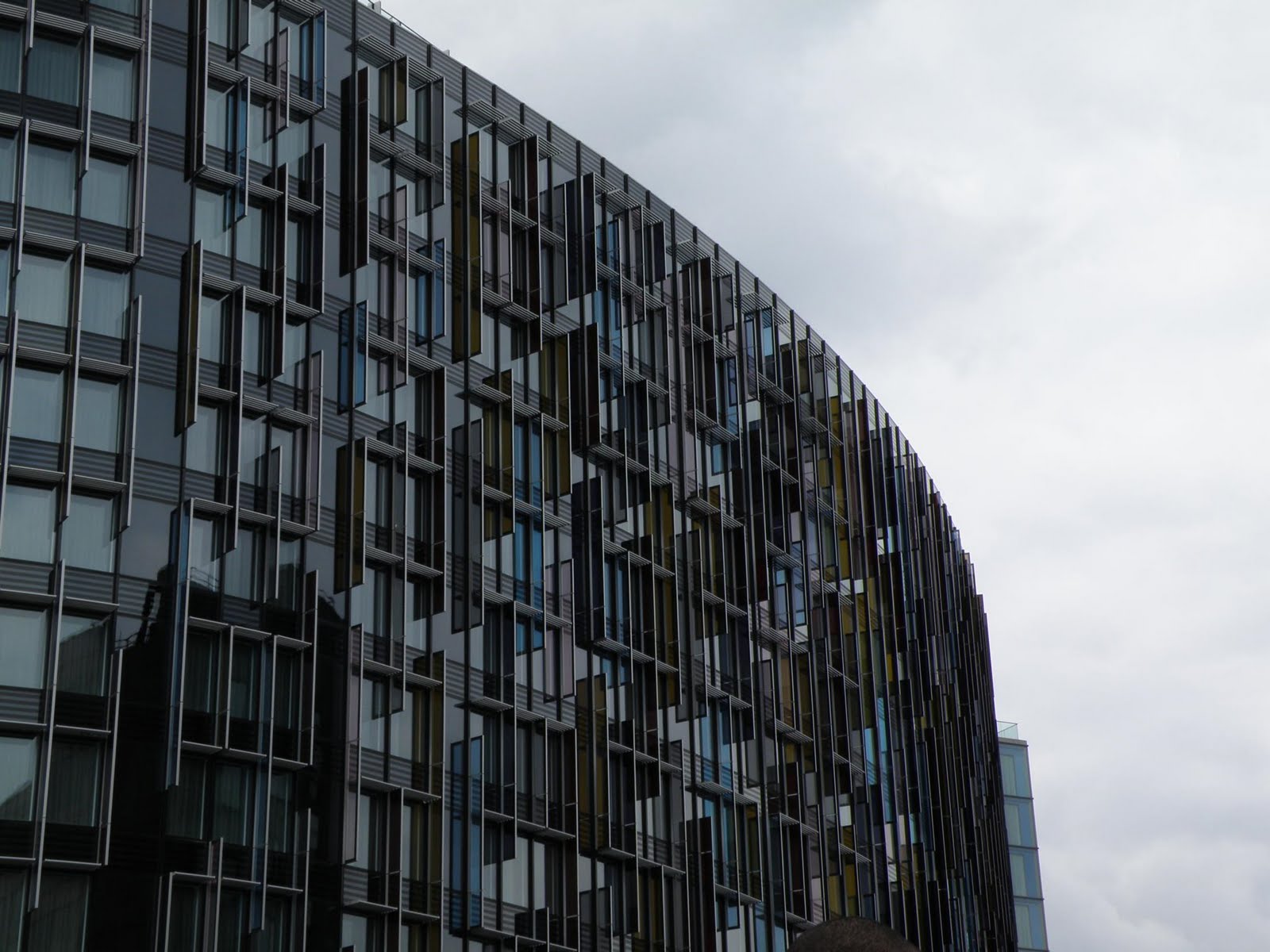
But you do see some contemporary and even quite striking architecture, too.


And again, back to the old.


How about this sign? Kate said it's a restaurant, but we didn't have time to eat there. But it was fun to see it all the same.


Grand Trunk Railway


There are pubs all over London, of course, and many of them have outlandish names.


We sampled the beer here, and it was quite tasty and refreshing after all that "exhausting" shopping!


I just liked these next few buildings; they epitomize London to me.


Wouldn't it be fun to leave your flat and see this monument every day?


I'd love to have a flat on the top floor in the tower.


The International Shakespeare Globe Centre was supposedly built on the site of his original theater. It would be fun to see Lady MacBeth on stage here, wringing her hands while exclaiming, "Out, damned spot!"


The famous St. Paul's Cathedral, the fifth build on the same site since AD 604. The previous ones were all destroyed by fire, primarily because of wooden roofs. After the fourth was destroyed by the Great Fire, Sir Christopher Wren designed the current cathedral, built beginning in 1677. He built it in English Baroque style which showed "more clarity of design and a subtle taste for classicism when compared to Baroque architecture on the continent" (not sure what that means). He also rebuilt 50 parish churches.

St. Paul's was the scene of many important events in the life of the British people. The cathedral was the site of funerals of notables like Lord Nelson, the Duke of Wellington and Winston Churchill. It was also the scene of many national and royal celebrations, including the wedding of Prince Charles and Lady Diana Spencer.

In these last two pictures, you can see shrapnel marks on the cathedral from German bombing in World War II.


Luckily, the cathedral survived the bombing.

Friday, September 24, 2010

Chapter 84 - Pumpkin Festival

The village held Kurbisfest, or Pumpkin Festival, two Sundays ago. Now, all I know about pumpkins is that you eat pumpkin pie at Thanksgiving. The first pumpkin pie was made by American colonists who sliced off the top of the pumpkin, removed the seeds, filled the insides with milk, spices and honey, then baked in hot ashes. Sounds tasty, doesn't it?

Living in Houston, I had no idea where pumpkins grow in the U.S., but I have learned that it's one of the most important U.S. crops where about 1.5 billion pounds are harvested each year. I know even less about "foreign" pumpkins. They originated in the New World (like potatoes, tomatoes and corn) and were taken back to Europe by the Spaniards. I just saw them in rustic displays at the grocery store, but now, living in the countryside, I guess it makes sense that I would see them growing in a field.

This is a small pumpkin patch in a field above the village.


Another thing I didn't know is that southeastern Austria (and a few neighboring areas) is the only place that makes pumpkin seed oil (kurbiskernol). The International Oil Pumpkin Conference is also held in this area. The oil is made from a specific mutant - Styrian oilseed pumpkin - with tender, non-woody, seed hulls. I'm not sure what pumpkin seed oil is used for, but then I'm woefully deficient in that kind of knowledge.

Bob by the Kurbisfest sign (bucna festa is Croatian).


The green ones are the ones that contain the pumpkin seed oil.


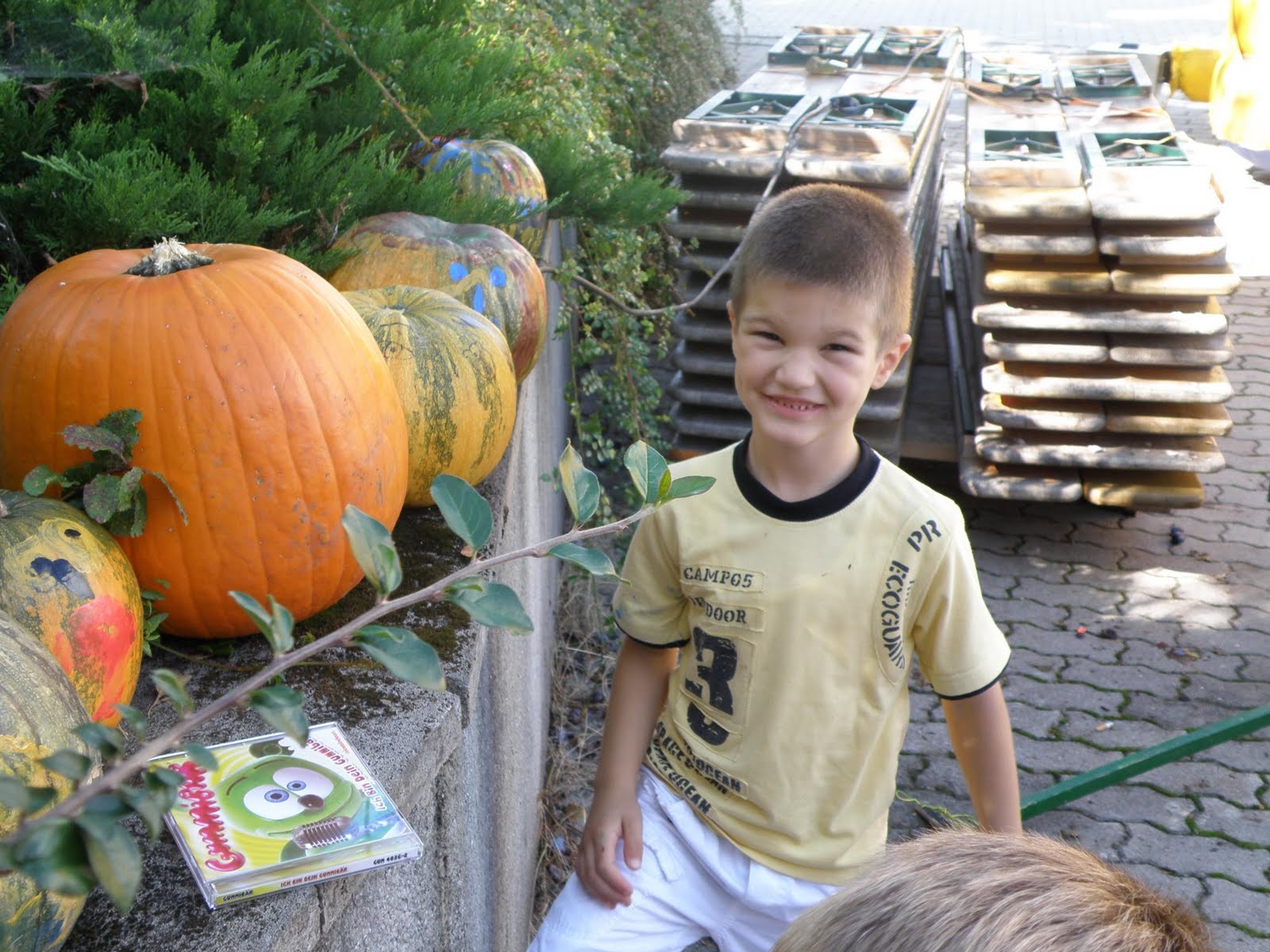
The orange one looked familiar with the funny face drawn on it.


Villagers at the festival


Some of our company friends


More of the pumpkins used to decorate the festival area


Villager Victoria volunteered to paint the children's faces.


Christine also did face-painting.


Dudo and Marija's four-year-old daughter, Mara, loved having her face painted.


She had one cheek done ...


... and then the other.


Some of the pumpkins look like giant squashes.


We had to leave for awhile and while we were gone, they had some contests. That big tub just in the picture was used for a volume displacement contest, and they also had a weight contest. The winner weighed something over 50 kilos (approx. 110 pounds).

These are decorative but clearly no size winner.


Village teens were available to serve wine, beer and schnapps, always available at any event in Austria.


More villagers enjoying the festival


Most of these pumpkins looked more familiar to me.


Company friend Miliana


Miliana and Bora's son, Milos


Barbara and her son, Phillip


Marija holding Chombe and Josipa's daughter, Zara


Mara and Zara


Kids everywhere love to jump.


Chombe holding daughter, Zara


She's only five months old, but she was moving her legs and trying to jump, too.


This is a girl in a hurry.


In the U.S. pumpkins are associated with pie for Thanksgiving but also as jack-o'lanterns at Halloween. I wondered how that tradition began and learned that it came from an Irish myth about a man known as "Stingy Jack." He invited the devil to have a drink but didn't want to pay (I think I know this guy). He convinced the devil to turn himself into a coin to pay for the drinks, then Jack kept it in his pocket next to a silver cross so the devil couldn't escape.

After more tricks like this, Jack eventually died, but of course God wouldn't allow such an unsavory cheapskate into heaven. And then the devil wouldn't let him into hell (don't get that one), sending Jack off into the darkness with only a burning coal to light his way. Jack put the coal into a hollowed turnip, and the Irish referred to his ghostly figure as "Jack of the Lantern," later just "Jack O'Lantern."

So people began to carve scary faces into turnips, potatoes and beets and set them on windowsills or near doors to frighten away Stingy Jack and other wandering evil spirits. When immigrants brought the tradition to the U.S., they discovered that pumpkins made perfect jack o'lanterns. I figure they used pumpkins because they were harvested right around Halloween in the U.S.

Unlike Linus, I won't be sitting in that little pumpkin patch overlooking Klingenbach on Halloween night. He'll have to wait for the Great Pumpkin by himself!