Friday, September 24, 2010

Chapter 84 - Pumpkin Festival

The village held Kurbisfest, or Pumpkin Festival, two Sundays ago. Now, all I know about pumpkins is that you eat pumpkin pie at Thanksgiving. The first pumpkin pie was made by American colonists who sliced off the top of the pumpkin, removed the seeds, filled the insides with milk, spices and honey, then baked in hot ashes. Sounds tasty, doesn't it?

Living in Houston, I had no idea where pumpkins grow in the U.S., but I have learned that it's one of the most important U.S. crops where about 1.5 billion pounds are harvested each year. I know even less about "foreign" pumpkins. They originated in the New World (like potatoes, tomatoes and corn) and were taken back to Europe by the Spaniards. I just saw them in rustic displays at the grocery store, but now, living in the countryside, I guess it makes sense that I would see them growing in a field.

This is a small pumpkin patch in a field above the village.


Another thing I didn't know is that southeastern Austria (and a few neighboring areas) is the only place that makes pumpkin seed oil (kurbiskernol). The International Oil Pumpkin Conference is also held in this area. The oil is made from a specific mutant - Styrian oilseed pumpkin - with tender, non-woody, seed hulls. I'm not sure what pumpkin seed oil is used for, but then I'm woefully deficient in that kind of knowledge.

Bob by the Kurbisfest sign (bucna festa is Croatian).


The green ones are the ones that contain the pumpkin seed oil.


The orange one looked familiar with the funny face drawn on it.


Villagers at the festival


Some of our company friends


More of the pumpkins used to decorate the festival area


Villager Victoria volunteered to paint the children's faces.


Christine also did face-painting.


Dudo and Marija's four-year-old daughter, Mara, loved having her face painted.


She had one cheek done ...


... and then the other.


Some of the pumpkins look like giant squashes.


We had to leave for awhile and while we were gone, they had some contests. That big tub just in the picture was used for a volume displacement contest, and they also had a weight contest. The winner weighed something over 50 kilos (approx. 110 pounds).

These are decorative but clearly no size winner.


Village teens were available to serve wine, beer and schnapps, always available at any event in Austria.


More villagers enjoying the festival


Most of these pumpkins looked more familiar to me.


Company friend Miliana


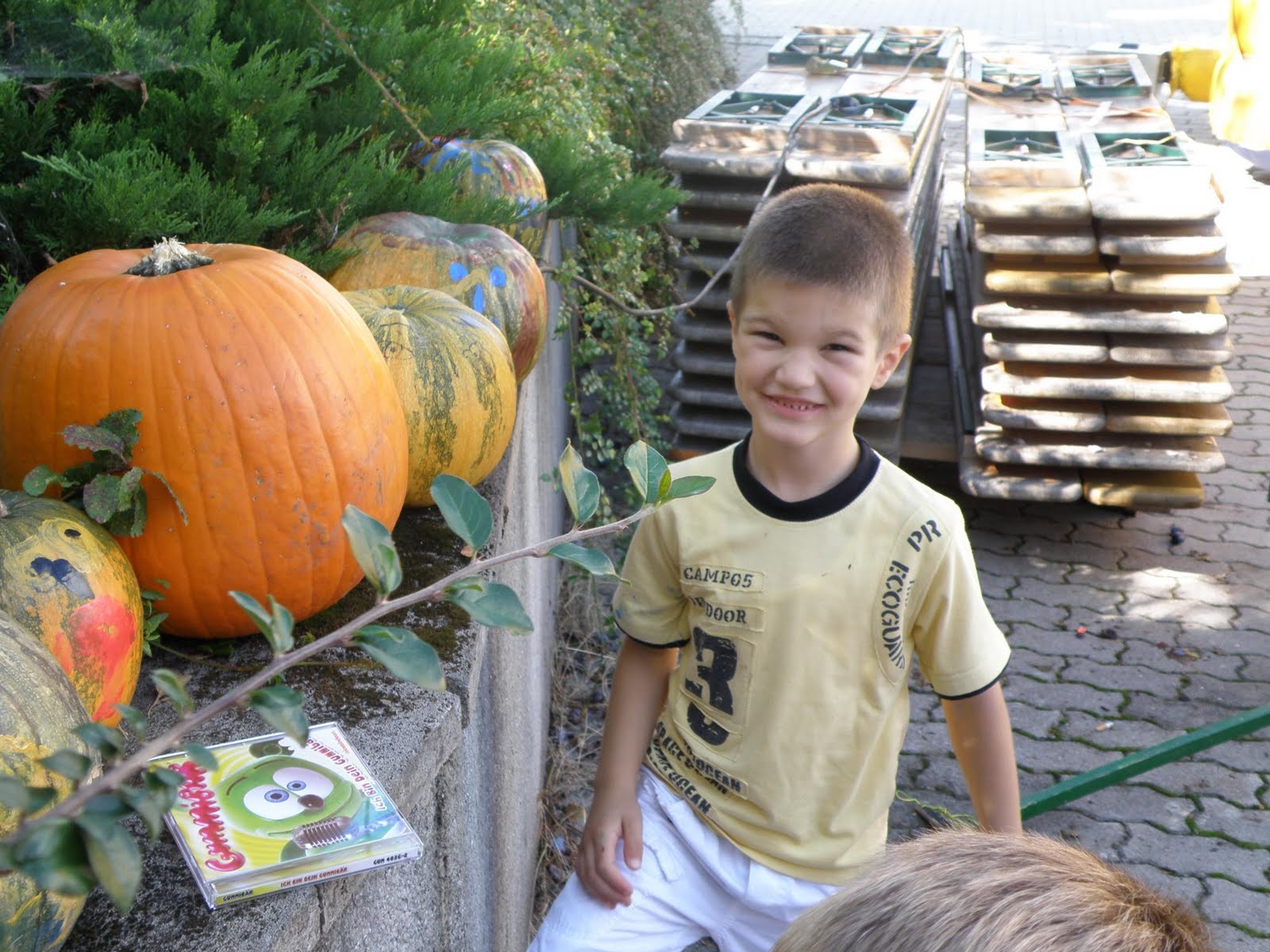
Miliana and Bora's son, Milos

Barbara and her son, Phillip


Marija holding Chombe and Josipa's daughter, Zara


Mara and Zara


Kids everywhere love to jump.


Chombe holding daughter, Zara


She's only five months old, but she was moving her legs and trying to jump, too.


This is a girl in a hurry.


In the U.S. pumpkins are associated with pie for Thanksgiving but also as jack-o'lanterns at Halloween. I wondered how that tradition began and learned that it came from an Irish myth about a man known as "Stingy Jack." He invited the devil to have a drink but didn't want to pay (I think I know this guy). He convinced the devil to turn himself into a coin to pay for the drinks, then Jack kept it in his pocket next to a silver cross so the devil couldn't escape.

After more tricks like this, Jack eventually died, but of course God wouldn't allow such an unsavory cheapskate into heaven. And then the devil wouldn't let him into hell (don't get that one), sending Jack off into the darkness with only a burning coal to light his way. Jack put the coal into a hollowed turnip, and the Irish referred to his ghostly figure as "Jack of the Lantern," later just "Jack O'Lantern."

So people began to carve scary faces into turnips, potatoes and beets and set them on windowsills or near doors to frighten away Stingy Jack and other wandering evil spirits. When immigrants brought the tradition to the U.S., they discovered that pumpkins made perfect jack o'lanterns. I figure they used pumpkins because they were harvested right around Halloween in the U.S.

Unlike Linus, I won't be sitting in that little pumpkin patch overlooking Klingenbach on Halloween night. He'll have to wait for the Great Pumpkin by himself!

Friday, September 17, 2010

Chapter 83 - Another Out and About

Living in Klingenbach has enabled us to see many things we'd never have noticed if we had simply come as tourists to Vienna. In this blog I'll highlight a few of the very different things we've seen.

The town of Korneuburg, nine miles northwest of Vienna, located in the state of Lower Austria, was founded in 1136 as a bank settlement. The town suffered through many military campaigns, including the Battle of Vienna, Thirty Years' War, War with Sweden in 1645 when they burned much of the town, French Revolutionary Wars, and the Oil Campaign of World War II.

This is the plague column, something I search for in every town.


Three views of the Rathaus (City Hall)


We were told that this is a new Rathaus; it's dated 1803.


Once again we saw that "new" and "old" mean different things in Europe.


An interesting tower


The inscription reads: "Korneuburg lies under 48 degrees, 20 minutes north latitude and 16 degrees 20 minutes east longitude from Greenwich. The median yearly temperature is 9 degrees Celsius, the median barometer reading is 747 m/m. The time ahead against Vienna is 8 seconds." Go figure - no one seemed to know why this inscription was here.


We happened onto this concert in the parking lot of our grocery store, Merkur - never found out the occasion.


Store patrons seemed to enjoy it.


The Feuerwehr (fire department) in Klingenbach held a festival for the townsfolk with good food and entertainment.


On a hot day what could be more fun than being squirted by the fire hose.


The equipment for the volunteer firefighters


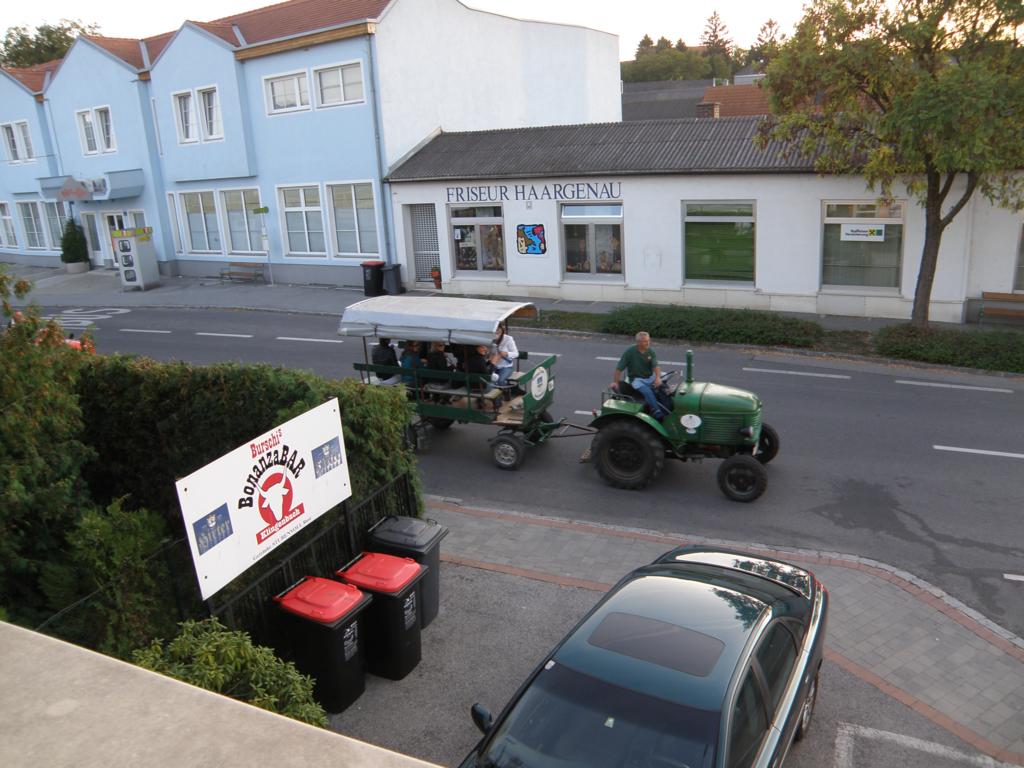
Attracted by screaming sounds one afternoon, I looked out the window and saw this parade of teenagers.


I found out later that they were celebrating a soccer team win.


It reminded me of homecoming parades back home albeit a lot smaller. It was just these two tractors and wagons.


Then they adjourned into Burschi's bar which is unlike America!


Steyr is a manufacturing town in the state of Upper Austria located at the confluence of the rivers Steyr and Enns. It was founded in 980 and has had a varied history, much of it marked by conflict. Besides all the earlier wars, it was the scene of battles between Social Democrats and Nazi fascists during the 1930s, and during World War II one of the sub-camps of the Mauthausen Concentration Camp was located here. Considerable war material was manufactured here during the war which of course attracted Allied bombers.

In 1945 units of the 5th Guards Airborne of the Soviet Army and black troops of the U.S. 761st Tank Battalion met each other on the bridge over the Enns River. Bob's Uncle Karl was a member of the 21st Armored Infantry Battalion, part of the 11th Armored Division, that invaded and occupied the town. Steyr was divided like Berlin and occupied by Soviet and American troops until 1955 when Austria officially declared neutrality.

I loved this old church.


Walking through the dark archway, I found this old inscription. The faded lettering was hard to read and was in Latin so I had to use an online translating site. From what I could tell it's a memorial to an important couple who died of plague. Bubonic plague epidemics were shattering events from 1348 (Black Death) to 1720 (last one in Europe took place in Marseilles). In all our time in Central Europe we haven't seen memorials to people who died of any other disease except plague.


This is another plague memorial.


I previously showed the Austrian/Hungarian border crossing at Klingenbach/Sopron. This is another one - at Pamhagen/Fertod.


This is a traffic sign just past the border.